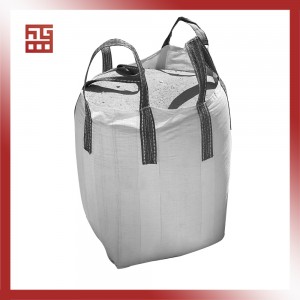
Belts in both directions
Parallel and perpendicular belts are sewn across the base and stitched at each crossing, so the load is shared across the floor rather than carried by one line.


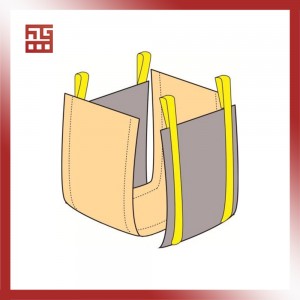
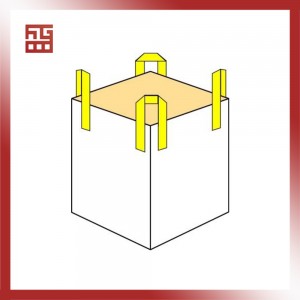
Common FIBC constructions side by side — top, loop and base combinations. Every model below is available in the dimensions, fabric weight and safety factor your load requires.

Extrusion, weaving, cutting, sewing, printing and inspection are completed in one facility, so fabric quality and stitching standards stay consistent from the first metre to the last bag.

In a # layout the belts run across the base in two directions — parallel and perpendicular — and are stitched where they cross. The floor is carried by a mesh instead of by one strap down the middle, and the four belt ends run up the sides to form the lifting points.
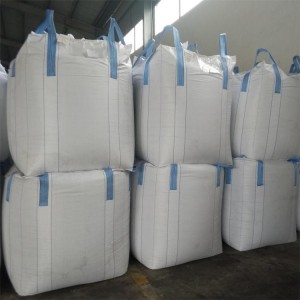
A filled bag sags where nothing holds it: the centre of the base, furthest from any seam. A grid puts support under exactly that area, so the base stays flat instead of bowing. That is what makes palletised stacking work — a bag whose floor has curved sits on its corners and rocks, and a pallet of rocking bags is a pallet that leans.
Because each belt is continuous from the base up to its lifting point, the lift pulls on the belt rather than on the seam alone. That is why this layout turns up where bags are lifted, set down and lifted again, rather than loaded once and forgotten.
A flat base is a stacking decision, not a cosmetic one — it is the difference between a pallet and a pile.
Parallel and perpendicular belts are sewn across the base and stitched at each crossing, so the load is shared across the floor rather than carried by one line.
The centre of the base is the area furthest from a seam and the first to bow. The grid sits directly under it, which is where the support is needed.
Each belt continues up the side and ends as a loop, so the lift force runs along the belt from the base to the hook without depending on the seam alone.
A base that stays flat sits square on the pallet. Bags that bow sit on their corners, rock under load and take the stack with them.
Chosen where the same bag is lifted and set down through the shift, or where the pallet is moved between warehouse and line more than once.
Top style, discharge, liner, coating and printing stay open. The # layout is a base specification; the rest of the bag is still built to your line.
Belt width and the number of runs across the base are set against the load rating, not chosen from a picture — send us the working load and the pallet footprint and we will confirm the layout. Stacking height should be agreed for your product and pallet: a flat base keeps the stack square, but how high it can go depends on what is inside and how it settles.
Length, width and height set to your filling line and container plan.
Webbing width, loop length and spacing matched to your hook or tines.
Basis weight and coating chosen for load, dust and moisture.
Artwork confirmed with you before the print run starts.
Bales are pressed and container-loaded to maximise each shipment. Ocean freight for full container loads, land transport for regional delivery, air freight available for urgent samples.

Cross corner for crane and hoist lifting, where the bag hangs from four diagonal points. Side-seam when bags run on automated lines and the footprint has to stay compact and repeatable.
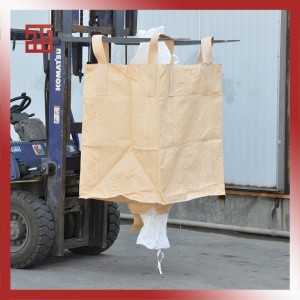
Yes. With the loops held upright, the tines pass through the loop openings for short-distance movement. For crane or hoist lifting, check that the hook or spreader bar is rated for the load.
Product must stay dry or the bag has to be dust-tight — choose coated. Product needs to breathe, or cost is the priority for a dry, coarse material — choose uncoated.
Bag size, target weight, the material, and how the bag is filled and emptied. That is enough for us to confirm fabric weight, loop specification and safety factor.